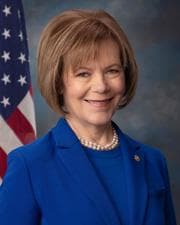
U.S. Senator
Tina Smith
Minnesota
DemocratProgressive
Contact
U.S. Senator
Minnesota
Contact
Voting Profile
Most Active Policy Areas
107
Votes Analyzed
Data sources: voteview, congress.gov
Political Position
Senator Tina Smith positions herself on the progressive end of the Democratic Party, with a voting record slightly more liberal than the average Democrat in the Senate. Her NOMINATE score of -0.409 reflects consistent support for Democratic policy priorities across most issue areas.
Near the average for Democrats (-0.38)
Data source: VoteView NOMINATE scores (UCLA/UC San Diego)
Policy Positions
107
total votes analyzed
Overview
Tina Smith has served as a U.S. Senator from Minnesota since January 2018, when she was appointed to fill the seat vacated by Al Franken. Her voting record demonstrates strong alignment with Democratic Party positions on most major issues. Smith's legislative focus appears concentrated in healthcare, where she has cast the largest number of recorded votes. Her voting pattern in this area shows engagement with healthcare policy debates, though her 54% 'yea' rate suggests she has opposed certain healthcare-related measures that came to the floor. On defense and national security matters, Smith has shown unanimous support for the measures that reached a vote during the period covered. Her infrastructure and banking votes also show full support, though the sample size in these areas is limited. Her budget and agriculture votes show 0% 'yea' rates, indicating opposition to specific proposals in these areas during the time period analyzed. This may reflect disagreement with the particular legislation rather than opposition to these policy areas broadly.
Key Positions
By Policy Area
Analysis updated: January 9, 2026
Campaign Finance
Includes all authorized campaign committees (principal committee, joint fundraising, and other authorized committees). Outside spending by Super PACs and independent groups is shown separately below. Verify on FEC.gov →
Career: $28.7M
Fundraising Over Time
Contribution Sources
84%
16%
Individual Breakdown
Itemized (>$200)
$1.4M
Small Dollar (<$200)
$1.1M
Donation Sizes
Share of individual contribution dollars by donation size, current election cycle.
Where the Money Comes From
Itemized individual contributions only (donations over $200 report the donor's state). Small-dollar donations are not included because the FEC does not itemize them.
Top Contributors
Top Contributing Industries
Top Donor Employers
Employer as self-reported by itemized donors. “Not Employed” and “Self-Employed” typically rank highest for small-dollar campaigns and include retirees.
Where the Money Goes
Spending by Purpose
Purpose categories are self-reported on FEC filings; large “Other” totals are common.
Top Payees
GRASSROOTS SOLUTIONS
CAMPAIGN COMPLIANCE LLC
AUTHENTIC CAMPAIGNS
PETERSEN GROUP
AMERICAN EXPRESS
NGP VAN, INC.
U.S. DEPARTMENT OF THE TREASURY
SCHIMANSKI & ASSOCIATES
Detailed Breakdown
Expenditures
Operating Costs
$3.4M
Operating Offsets
$25K
Net Operating
$3.4M
Transfers
Transfers Out
$500
Refunds
Individual Refunds
$104K
Committee Refunds
$61K
Outside Spending (Super PACs)
Supporting
$2.7M
Opposing
$911K
Total Outside Spending
$3.6M
Top Outside Spenders
PLANNED PARENTHOOD OF MINNESOTA POLITICAL ACTION FUND
SEIU COPE (SERVICE EMPLOYEES INTERNATIONAL UNION COMMITTEE ON POLITICAL EDUCATION)
PLANNED PARENTHOOD ACTION FUND INC
ALLIANCE FOR A BETTER MINNESOTA FEDERAL PAC
RIGHT NOW USA
AMERICAS PAC
VALOR AMERICA
PLANNED PARENTHOOD VOTES
Independent expenditures are made without coordination with the candidate. Source: FEC Schedule E filings.
Voting Record
87 votes across 12 categories